





Trek Slash+ Buyer Guide UK (2026) | Slash+ 9.7 vs 9.9 vs Fuel+ LX Comparison
Understanding the difference between the Slash+ and Fuel+ LX — and working out which one actually suits your riding.

The Slash+ and Fuel+ LX are both premium lightweight e-MTBs built for riders who want serious descending capability with motor assistance. They share the same TQ HPR60 motor and 580Wh battery, so power and range are identical across all three bikes. What changes is how they ride. The Slash+ borrows its suspension design from Trek's Session downhill bike — mullet wheels, 170mm travel, everything pointed at getting down the hill. The Fuel+ LX is the longest-travel Fuel+ you can get — full 29er, 160/170mm, coil shock. Still aggressive, but built to handle proper days out, not just laps. If you're choosing between these bikes, the question isn't about power — it's about what you want the bike to do best.
You can see the current bikes available in our Trek Slash+ range here →
Same motor, same battery, very different bikes — the choice comes down to how you want to ride.
Slash+ 9.7 vs Slash+ 9.9 vs Fuel+ LX 9.9
All three bikes run the TQ HPR60 motor with 60Nm and a 580Wh battery — same power, same range, across the board. They're all carbon, all full-suspension, all built for riders who like things steep and rough. None of these are touring bikes — they're for people who want to get down the hill properly and use the motor to do it again.
The biggest difference is what's going on with the suspension — the Slash+ runs Trek's high-pivot layout with an idler pulley, the Fuel+ LX uses a traditional setup with a coil shock. We'll explain what that actually means on the trail further down. Beyond that, the Slash+ is mullet (29/27.5) with 170mm rear travel, the Fuel+ LX is full 29er with 160mm rear. Between the two Slash+ models, the 9.9 upgrades suspension damping, adds wireless shifting and carbon wheels.

Slash+ 9.7
Best for: Riders who want the Slash+ ride feel and descending capability without paying top-tier prices for components they may never need.
Ride feel: The 9.7 feels planted and composed on rough descents. The high-pivot suspension lets the rear wheel move out of the way of square-edge bumps rather than getting knocked off line — you notice it most on rocky, rooty trails where other bikes would get kicked around. The Fox 38 Performance fork and Float X shock handle the big hits well — you feel the bike working with the trail rather than fighting it. On climbs the idler pulley keeps pedalling smooth, though you'll notice the bike is happiest when pointed downhill.

Slash+ 9.9
Best for: Riders who want the best suspension and components the Slash+ platform offers, with wireless shifting and carbon wheels.
Ride feel: The 9.9 is a noticeable step up in how controlled the bike feels. The RockShox ZEB Ultimate fork with Charger 3.1 damper gives a more precise front end — it tracks better at speed and stays composed under hard braking. The Vivid shock at the rear adds better mid-stroke support, which means the bike holds its composure through repeated rough sections where the 9.7 might start to feel a bit loose. Carbon wheels also reduce rotating weight, which makes the bike feel sharper through direction changes.

Fuel+ LX 9.9
Best for: Riders who want proper descending confidence but also want a bike that doesn't fight them on longer, mixed rides.
Ride feel: The Fuel+ LX feels different from the Slash+ from the first pedal stroke. It's a full 29er with a Fox DHX2 coil shock, which gives it a very planted, consistent feel regardless of what the trail is doing. With 160mm rear and 170mm front it's not far off the Slash+ for travel, but the geometry is slightly steeper and the bigger rear wheel carries more speed through rough sections. It climbs more naturally and feels more composed on longer rides where you're pedalling as much as descending.
The Slash+ is the bike if you want the most capable descender in Trek's e-MTB range. The Fuel+ LX is the bike if you want nearly as much travel but a more rounded ride. Between the two Slash+ models, the 9.9 justifies its price for riders who consistently push hard on demanding terrain.
Start With How You Ride
If you're looking at these bikes, you already know you want something aggressive — the question is what kind of aggressive.
Start with how you actually spend your time on the bike. That'll tell you more than any spec sheet.
What does a typical ride look like for you?
Think about your last few rides. Were you basically climbing to earn descents, or were you covering proper ground and mixing it up?
This tells you whether you need a bike optimised for descending or one that balances descending with longer days.
→ If your rides are mainly about getting to the top and sending it back down — Slash+ 9.7 or 9.9. If your rides mix serious descents with longer climbs and distance — Fuel+ LX 9.9.
How important are top-tier components and suspension control?
You feel the difference between mid-range and premium suspension most when you're riding fast on rough trails over and over — that's when the fork and shock need to hold it together hit after hit.
If your riding consistently pushes the bike hard, better suspension pays for itself in confidence and control.
→ If you want the Slash+ experience at a more accessible price — Slash+ 9.7. If you want the best suspension and wireless shifting for harder riding — Slash+ 9.9. If you want premium everything with a coil shock for consistent all-day performance — Fuel+ LX 9.9.
How much do you value simplicity and adaptability?
The Fuel+ LX can be converted to EX or MX configuration with aftermarket links — so if your riding changes, your bike can change with it. The Slash+ is a dedicated platform with no configuration options.
The Fuel+ also has fewer moving parts in the suspension — no idler pulley to maintain, no chain guide to check.
→ If you want a dedicated descending machine and you're happy committing to that — Slash+. If you value the option to adapt the bike over time and want less to maintain — Fuel+ LX 9.9.
Model Breakdown
Slash+ 9.7
The full Slash+ experience at the most accessible price.

Same carbon frame, same suspension design, same motor as the 9.9 — the difference is component spec. For most riders, this is more than enough bike.
Key Points
- High-pivot suspension with idler pulley — same design as the 9.9
- Fox 38 Performance fork and Float X shock — capable and reliable
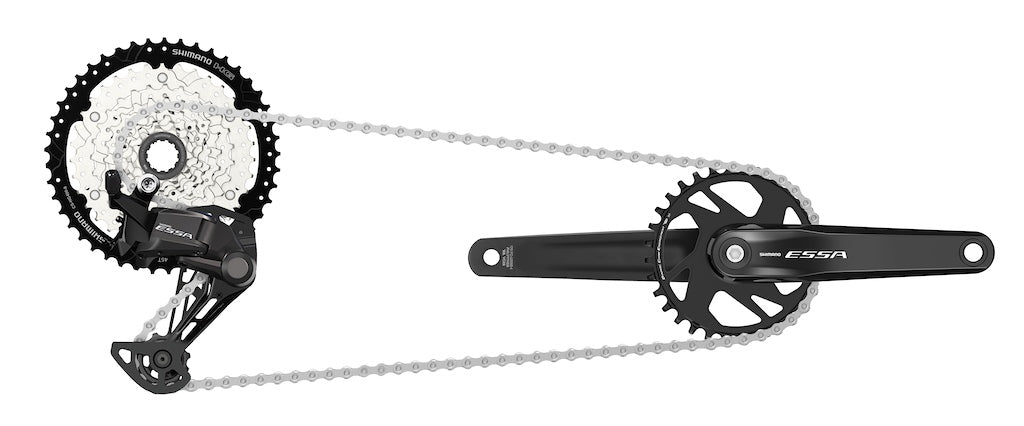
- SRAM Eagle 12-speed mechanical drivetrain
- £3,000 less than the 9.9 for the same frame and motor platform
Who it suits
The 9.7 suits riders who want the Slash+ descending capability without paying for top-tier components. If you're not racing enduro or consistently pushing the bike to its absolute limits, the 9.7 delivers the same ride character as the 9.9 at a significantly lower price.
Slash+ 9.9
The full send — best components, wireless everything.

Better damping, lighter wheels, wireless shifting, wireless dropper. It's the Slash+ with nothing held back.
Key Points
- RockShox ZEB Ultimate fork with Charger 3.1 damper
- RockShox Vivid shock — more controlled on repeated rough hits
- SRAM X0 AXS wireless shifting and RockShox Reverb AXS dropper
- Bontrager carbon wheels — lighter, stiffer, more responsive
Who it suits
The 9.9 suits riders who ride hard and often enough to feel the difference that premium suspension makes. If you're regularly on steep, rough terrain and you want the bike to stay composed when you're pushing the pace, the upgraded damping and reduced weight make a tangible difference.
Fuel+ LX 9.9
Long-travel aggression with all-day versatility.

The Fuel+ LX is the longest-travel Fuel+ you can get — built for riders who want to push into more aggressive terrain without giving up the versatility to ride all day.
Key Points
- Fox Factory 38 fork — same chassis quality as the top Slash+
- Full 29er wheels — carry more speed, roll smoother
- Traditional suspension layout — simpler, less maintenance
- Convertible — can be switched to EX or MX setup with aftermarket links
Who it suits
The Fuel+ LX suits riders whose riding mixes steep descents with proper distance. If your days involve two or three big descents but also a lot of pedalling between them, this bike won't punish you for the climbing the way a more focused descending bike might. It's also worth considering if you like the idea of being able to change the bike's setup down the line.
What does high-pivot actually do — and do you need it?
High-pivot suspension gets talked about a lot online, but most of that conversation is engineering detail rather than what it actually feels like when you're riding. If you're comparing the Slash+ to the Fuel+ LX, this is the single biggest difference between them — and it's worth understanding in plain terms.
Trek's high-pivot design on the Slash+ is borrowed directly from the Session, their World Cup downhill race bike. Same core concept — just adapted for a lighter, pedal-assisted platform. The Fuel+ LX uses a more traditional suspension layout. Both work well, but they work differently.
How the rear wheel moves differently
On a traditional suspension bike like the Fuel+ LX, the rear axle moves in an arc — mostly upward when the suspension compresses. On the Slash+, the high pivot point means the rear axle moves both upward and rearward. In practice, this means the rear wheel moves away from square-edge bumps rather than being pushed into them. It's like the difference between stepping over a kerb and stepping off it — one stops you, the other lets you keep moving. On rough, rocky descents this makes the Slash+ feel noticeably smoother and less likely to get kicked off line.
What the idler pulley does
The trade-off with a high pivot is that without the idler, the chain would pull against the suspension and make pedalling feel horrible. Trek sorts this with an oversized idler pulley near the top of the frame that reroutes the chain. It works well — pedalling feels smooth — but it's one more thing on the bike that needs looking after.
Which approach suits which rider
If your riding consistently involves steep, rough descents where maintaining traction and composure matters most, the high-pivot Slash+ gives you a genuine advantage. If your riding is more varied — mixing technical descents with longer climbs and bigger mileage days — the Fuel+ LX's traditional suspension is simpler, lighter in feel, and equally capable for the way most trail riders actually ride. Neither is better full stop — they're just built for different priorities.
Why Buy From All Ride Now?
You're spending between six and ten grand here — getting it right matters.
We've sold and serviced both platforms and can talk you through how each one actually rides — not just what the spec sheet says.

Advice from riders who know how these bikes perform on real trails.
When you buy from us:
- Specialist knowledge of the Slash+ and Fuel+ platforms including suspension setup
- Honest advice on which one actually suits you — we'd rather sell you the right bike than the most expensive one
- Professional build and suspension setup before your first ride
- Ongoing servicing and support from a workshop that knows both platforms inside out
If you're weighing up these bikes, talking it through with someone who knows both will save you from spending thousands on the wrong one.
Frequently Asked Questions
Can the Fuel+ LX be converted to an EX or MX setup?
Yes. Trek designed the Fuel+ with interchangeable rocker links and lower shock mounts, so you can convert between EX (145/150mm, full 29er), MX (150/160mm, mullet) and LX (160/170mm, full 29er) configurations. The LX to MX swap only requires the rocker link, lower shock mount and a 27.5-inch rear wheel. Switching to EX also requires a different stroke shock. We can advise on what's involved if you're interested.
Does the Slash+ high-pivot suspension need more maintenance than a traditional setup?
The idler pulley is an additional component that needs periodic checking and occasional bearing replacement, but it's straightforward workshop work — not dramatically more than a traditional bike. We recommend having the idler checked during your regular service intervals. The rest of the suspension maintenance is the same as any other full-suspension bike.
Is the 580Wh battery enough for long days on these bikes?
For most riders doing aggressive trail riding with lots of climbing, the 580Wh battery will comfortably cover a full day. Exact range depends on terrain, assist mode and rider weight, but as a rough guide many riders get 3–5 hours of mixed riding. All three bikes are also compatible with TQ's 160Wh range extender if you want extra capacity for bigger days.
What size should I look at — and do the smaller sizes run different wheels?
Yes — the Slash+ small runs 27.5-inch wheels front and rear rather than the mullet setup on medium and above. The Fuel+ LX small comes with a mullet setup as standard for better rider proportions. We'd always recommend talking through sizing with us before ordering at this price point — fit matters more than spec when you're spending this much.
Can I run a coil shock on the Slash+?
Yes, the Slash+ frame is coil compatible. If you prefer the consistency of a coil shock — similar to what the Fuel+ LX runs as standard — it's a straightforward swap. We can advise on the right spring rate for your weight and riding style.
Your Next Step
Got a question? Hit the live chat button — bottom left of this page. It's Dan, not a bot. If he's with a customer he'll be back within the hour.
Rather talk? Call us on 01730 817563. Dan or the team are in the shop Tuesday to Saturday — afternoons are best.
Ready to see what's available? View the full Slash+ range and Fuel+ range — all current models, colours and pricing.
Still deciding between the Slash+ and the Fuel+ LX?
Ask Dan directly
— he's helped hundreds of riders find the right bike and there's no pressure, no script, just an honest conversation.